
From the West Indies to the First World War:
Stories from No. 2 Construction Battalion and Black Soldiers
Private Robert Henry James (1888 – 1955):
Father, Soldier, Porter
Biography
Robert Henry James was born in St. John’s, Antigua, British West Indies, on 4 March 1888, the son of George and Ann Elizabeth (Williams) James. No information is available on Robert’s life in Antigua prior to his immigration to Canada in 1905.
On 6 April 1909, Robert married Lillian “Lily/Lillie” May Slade in Lunenburg, Nova Scotia. Born on 31 January 1889 in Lunenburg, Lily was the daughter of William and Minnie Slade. Robert and Lillie’s son, Kelly Douglas James, was born in First South, Lunenburg County, on 18 June 1909. The following year, Robert became a naturalized Canadian.
At the time of the 1911 Canadian census, the James family was living in Lunenburg, where Robert was employed as a labourer. When Robert enlisted with No.2 Construction Battalion at Halifax, NS, on 8 August 1916, he and Lillie were residing at 183 Creighton Street, Halifax, with their son, Kelly.
No known photographs of Robert are available. According to his service file, he was five feet five inches tall, with a dark complexion, brown eyes, and black hair, and weighed 145 pounds (66 kilograms). His attestation also describes scars on his neck, right “grind” [sic] and both shins.
On 20 September 1916, Robert was promoted to the rank of Lance Corporal. An extended “absence without leave” the following month resulted in a reduction in rank to Private, a significant loss of pay, and 60 days detention. He returned to the unit’s ranks in mid-December 1916 and departed overseas with the unit aboard SS Southland on 28 March 1917.
In mid-May 1917, Robert proceeded to France with a large contingent of No. 2 Construction personnel and travelled to the Jura mountains, near the Franco-Swiss border. He spent the entire period of his overseas service there, working alongside Canadian Forestry Corps Companies already stationed in Jura. Other than a two-week leave to the United Kingdom in mid-August 1918, his time in France was uneventful.
Robert returned to the United Kingdom with his No. 2 Construction comrades in mid-December 1918 and departed for Canada aboard SS Empress of Britain on 12 January 1919. He was officially discharged from military service at Halifax on 13 February 1919.
At the time of his return, Lillie and Kelly Douglas were living on Charles Street in Halifax’s North End. Throughout the rest of his life, Robert and his family resided in the same area, as did most members of the Black community who did not live in Africville, the historic Black settlement situated along the Bedford Basin.
While the 1921 Canadian census once again described Robert’s occupation as “labourer,” he subsequently found employment with Canadian National Railway (CNR) as a sleeping car porter and custodian. He retired in 1948, after 23 years of service.
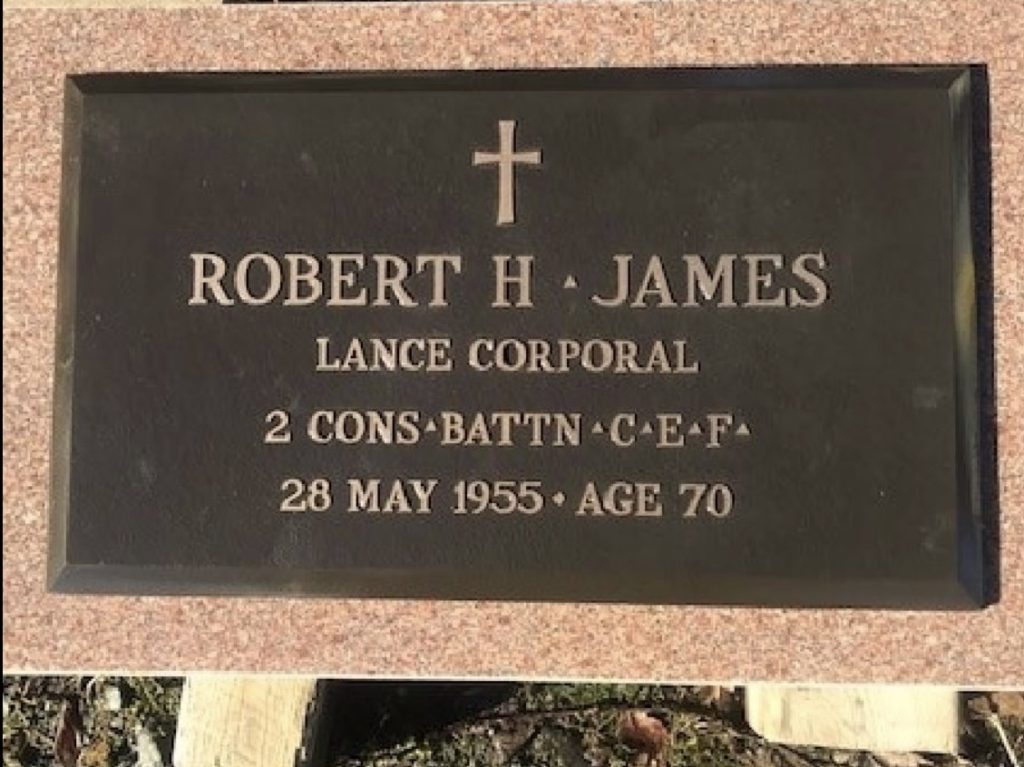
Robert James died in Camp Hill Hospital, Halifax, on 28 May 1955 after a five-month battle with cancer and was interred in Hillcrest Memorial Gardens—now known as Pleasant Hill Cemetery—Lower Sackville, Nova Scotia. Robert and Lillie’s only child Kelly James never married and died suddenly in his Maynard St., Halifax, home on 20 February 1961. Lillian May (Slade) James passed away in Nine Mile River, Hants County, on 18 November 1967.
Census Records
The census is an institution that unites all Canadians. It is one of the main tools that the Canadian government uses to categorize and analyze people across the nation. However, census records do not always work in harmony with one another as each census is conducted by different people at different times, sometimes with new categories and standards for data collection. While there may be some issues with accuracy, these documents are a snapshot of the nation’s people. It is important to remember that these are historical documents influenced by the attitudes and norms of the day.
Supplementary Material
This additional material was consulted by Toronto Ward Museum researchers to fill in Robert Henry James’ story. Some materials are indirectly related to the solider, but help provide a fuller understanding of who he was. What other information sources would you look for if you wanted to know more?