
From the West Indies to the First World War:
Stories from No. 2 Construction Battalion and Black Soldiers
Doctor Hewburn Nathaniel Greenidge
(1893 – 1921):
A Bridge Between Worlds
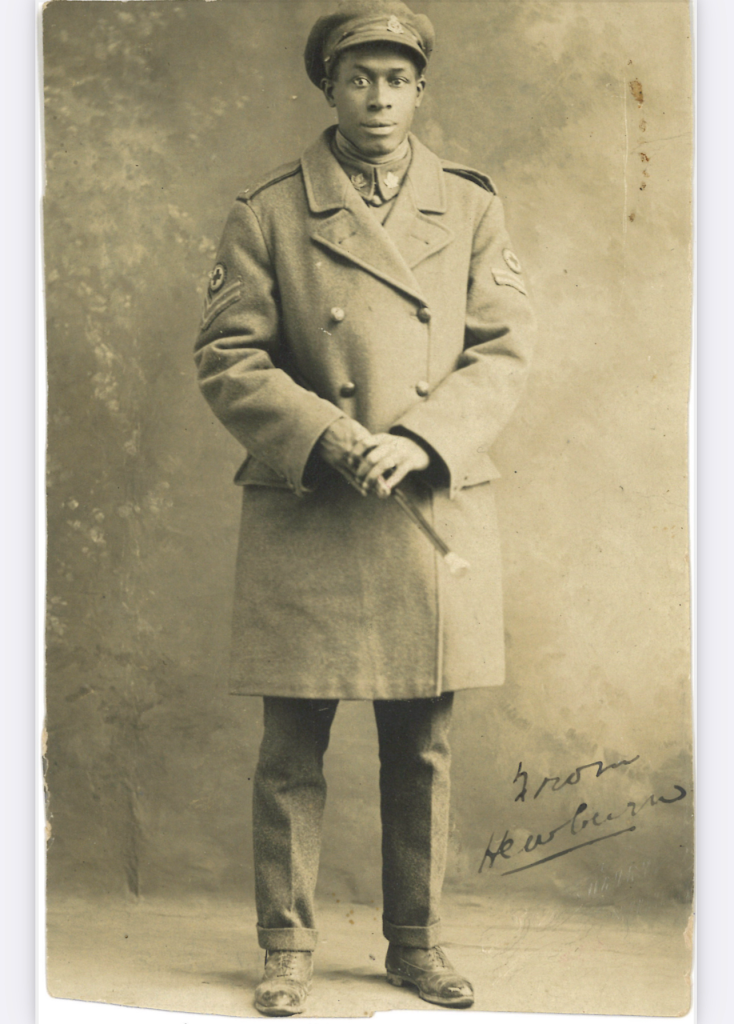
Biography
Hewburn Greenidge was born on 1 November 1893 in Georgetown, British Guiana (now Guyana). His family background reflects the interwoven history of the Caribbean—both of his parents, Joseph Daniel Greenidge and Ellen Beatrice (née Hope), were born in Barbados. After the abolition of slavery on the island (1834–1838), many Afro-Caribbean people sought new opportunities. An estimated 45,000 Barbadians migrated to British Guiana between 1835 and 1928. The Greenidges where part of this diaspora of aspiring Black middle-class families striving for advancement under colonial rule. They valued education and hard work, and were part of a new generation of businesspeople, what we now call entrepreneurs.
As the eldest of seven siblings, young Hewburn Greenidge was imbued with this ethic of self-improvement and a value for education. In the 1890s, two of his maternal aunts had emigrated from Barbados to Canada, settling in Winnipeg, Manitoba. This early Caribbean-Canadian connection laid a foundation for the Greenidge children. The four oldest siblings, including Hewburn, were sent to Canada to join their aunts and pursue higher education. Such migration was uncommon but significant; Winnipeg—and Canada’s prairies in general—saw only a small wave of Afro-Caribbean immigrants in the early 1900s, often educated or professional individuals seeking greater opportunities.
In 1913, 19-year-old Hewburn arrived in Winnipeg to attend the Manitoba Medical College, the medical faculty of the University of Manitoba. At that time, the institution had barely begun admitting non-white students. In fact, Greenidge became its first Black student in medicine, a distinction noted in a 1915 class photograph that highlighted “the University’s first black student”, Dr. Hewburn Greenidge from “British Guiana,” among a diverse group of peers. Classmates and instructors described him as a bright and disciplined student, more of a quiet scholar than a crusader, with a good sense of humour and an intense curiosity for science and discovery. He was known for his charm, carried himself with composure and excelled academically, even as he navigated an environment where few looked like him.
Not long after Hewburn began his medical studies, the First World War engulfed Europe and the British Empire. In 1916, with the war in its third year, he made the pivotal decision to put his education on hold and enlist in the Canadian Expeditionary Force. On 21 November 1916, Hewburn Greenidge joined No. 2 Construction Battalion, the largest Canadian military unit composed primarily of Black soldiers during the First World War.
Greenidge was one of 11 Black residents of Winnipeg to serve with No. 2 Construction Battalion. With six months of University Officer Training Corps service and a medical background, he could have enlisted with a medical unit, but racism may have played a part in not taking this route. During his enlistment medical, one of the doctors was heard to make a highly racist comment about him. This may have reflected how he was treated by some in the Winnipeg medical community.
In March 1917, Hewburn sailed from Halifax with his battalion aboard SS Southland, arriving in Liverpool, England. Two months later, he was deployed to the Canadian Forestry Corps’ Jura District, near the Franco-Swiss border, with 500 other members of the unit. Greenidge served there honourably as a Corporal. In France, many of the unit’s soldiers performed specialized duties commensurate with their civilian skills. It is therefore likely that Greenidge treated No. 2’s soldiers in the unit’s small medical facility.
In mid-1917, the Canadian government became concerned that, with so many doctors serving overseas, there might not be enough in Canada to support both the Canadian populace and the Canadian Expeditionary Force. As a result, on 24 September 1917, the Militia authorized the return to Canada of all dental and medical students who had completed at least one year of medical training to continue their university studies.
Corporal Hewburn Greenidge was among the 230 military overseas personnel repatriated to return to their studies. He arrived in England on 16 November 1917 and was back in Winnipeg by 7 February 1918. He officially received his discharge, for the purpose of resuming medical studies, on 2 December 1917. After more than a year in uniform, Hewburn exchanged his army khaki for academic robes. His war service, however, left an indelible mark. The experience of witnessing firsthand the devastation of war and disease broadened his perspective and reinforced his commitment to healing. Greenidge returned to university with a renewed sense of purpose and discipline forged in the crucible of war.
Back at the University of Manitoba, Hewburn Greenidge resumed his medical studies with vigour in 1918, quickly making up for lost time. By May 1920, he had completed the program and graduated with his medical degree (M.D.). In doing so, Dr. Greenidge became the first Black person to graduate from the University of Manitoba and thus its first Black physician alumnus. A contemporary newspaper celebrated the accomplishment with the headline “Coloured man gets M.D.” in the Manitoba Free Press.
Rather than immediately settling into private practice, Dr. Greenidge sought advanced training to further expand his skills. According to family accounts, he had always been fascinated by the natural world and had spent part of his childhood accompanying Indigenous elders in British Guiana’s rainforests, learning about traditional herbal medicine and remedies found in nature. Eager to merge this traditional knowledge with formal science, Hewburn travelled to England after graduation. Around 1920, he enrolled in the School of Tropical Medicine, Liverpool, one of the leading centers for tropical disease research at the time. There, he studied pharmacology and tropical diseases, delving into the chemistry of healing plants and the pathology of ailments like malaria, parasitic infections, and fevers endemic to the tropics. Dr. Greenidge was fascinated by medicine and science; for him, it was more than a profession, it was a calling intertwined with service. His younger sister, Claudine, later noted that Hewburn “had an immense sense of duty to relieve suffering,” which drove him to acquire knowledge that could benefit those back home who lacked access to modern medicine.
After roughly a year in England expanding his medical horizons, Dr. Greenidge returned to Canada briefly and practiced in Winnipeg in 1921. By now, the Greenidge family was becoming prominent and was among the first families in Georgetown to own an automobile, a symbol of status at the time. Yet for Hewburn, material comfort or an easier life in Canada held little sway. He felt compelled to return home to British Guiana to put his hard-earned expertise to use where it was needed most. In mid-1921, he voyaged back to Georgetown, officially to visit his parents, but with the clear intention of serving his people and continuing his research in the interior.
Once back in British Guiana, Dr. Greenidge wasted no time in entering the fray of public health challenges. Instead of remaining in the relative comfort of Georgetown (the capital), he chose to work in the remote interior regions of the colony. At that time, the interior rainforest and riverine communities had very limited medical services, often only a rudimentary clinic, if anything. Tropical diseases like malaria, dysentery, and parasitic infections were rampant, and traditional bush medicine was the first—and only—line of defence for many Indigenous people and African-descended villagers. Dr. Greenidge saw great potential in bridging his scientific training with the traditional remedies he had learned about in his youth. He believed that within Guiana’s forests were “untapped reserves” of medicinal plants that could yield cures for illnesses afflicting not only Guianese, but possibly the wider world. Armed with both a modern medical degree and respect for traditional knowledge, he ventured deep into the bush to conduct field research on herbal treatments and to care for the sick.
Working in these frontier conditions was arduous. Dr. Greenidge often trekked by canoe and on foot to reach isolated settlements along the rivers. Family lore is that he set up makeshift laboratories to analyze plant samples and improvised clinics to treat patients suffering from tropical fevers. Reports from family and colleagues describe him treating maladies ranging from malaria to pneumonia in villages that had never seen a formally trained doctor.
Tragically, Dr. Greenidge contracted a serious infection while in the interior, likely from contaminated food or water in the harsh field conditions. Contemporary accounts are sparse, but oral stories suggest he was stricken with a combination of a pulmonary illness and a gastrointestinal infection. In an era before antibiotics, such an infection was extremely difficult to treat, even for a doctor. Hewburn was transported back towards the coast and given whatever medical care was available, but his condition deteriorated over the course of several months. Despite his own knowledge and the aid of colleagues, the young doctor could not fight off the illness he had likely acquired in the line of duty.
On November 20, 1921, Dr. Hewburn Greenidge died in British Guiana at just 28 years of age. He was laid to rest in the very interior region that he had come to serve.
Additional Research Outcomes
Census Records
The census is an institution that unites all Canadians. It is one of the main tools that the Canadian government uses to categorize and analyze people across the nation. However, census records do not always work in harmony with one another as each census is conducted by different people at different times, sometimes with new categories and standards for data collection. While there may be some issues with accuracy, these documents are a snapshot of the nation’s people. It is important to remember that these are historical documents influenced by the attitudes and norms of the day.
Supplementary Material
This additional material was consulted by Toronto Ward Museum researchers to fill in Hewburn Nathaniel Greenidge’s story. Some materials are indirectly related to the soldier, but help provide a fuller understanding of who he was. What other information sources would you look for if you wanted to know more?
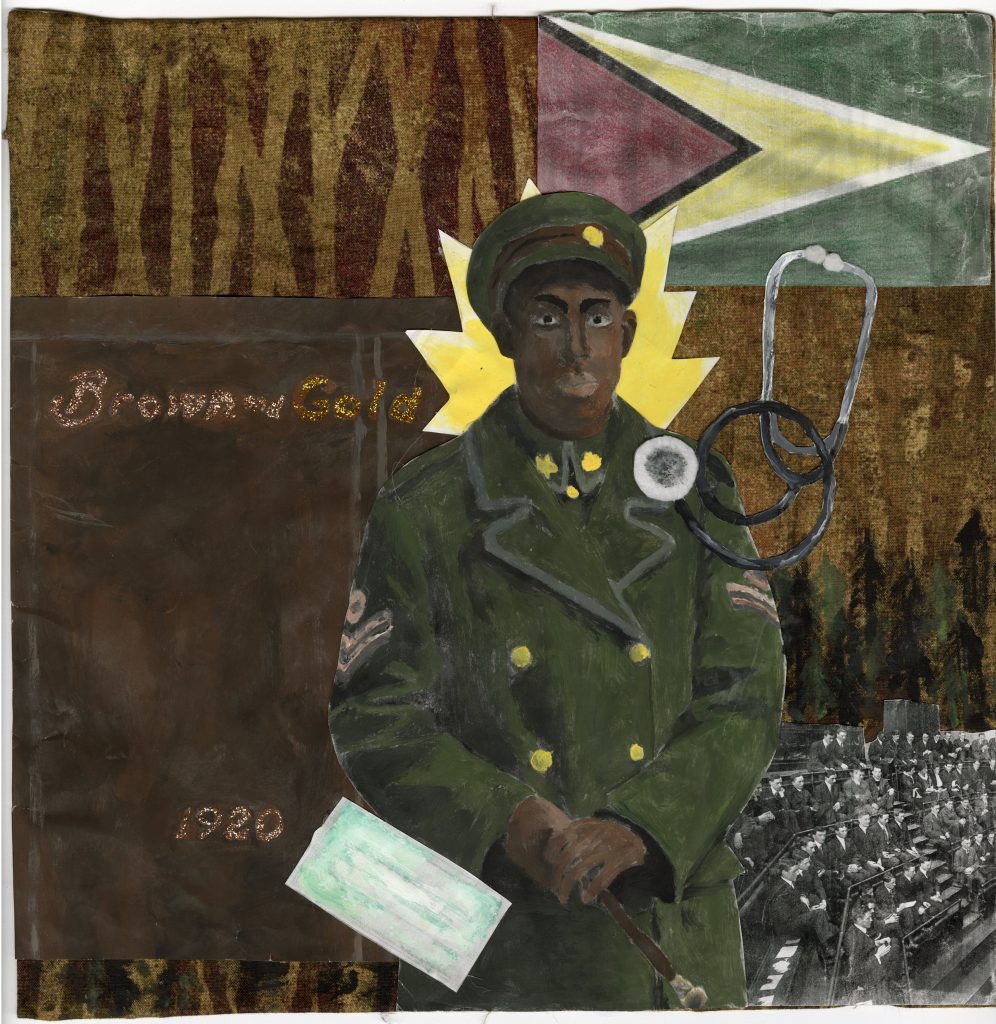
Brown and Gold, the Year Book of the University of Manitoba Students’ Union, 1920 vol. 1, is available in the digital collections of the University of Manitoba Library. Hewburn Nathanial Greenidge’s portrait and biography are on page 63.