
From the West Indies to the First World War:
Stories from No. 2 Construction Battalion and Black Soldiers
Corporal Albert Carty
(1879 – 1958):
A Family of Service
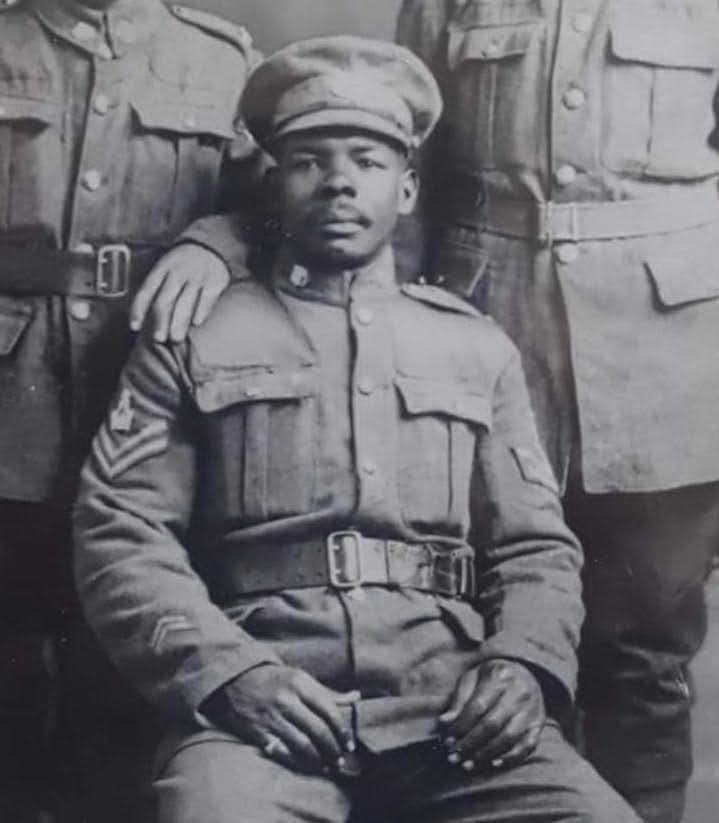
Biography
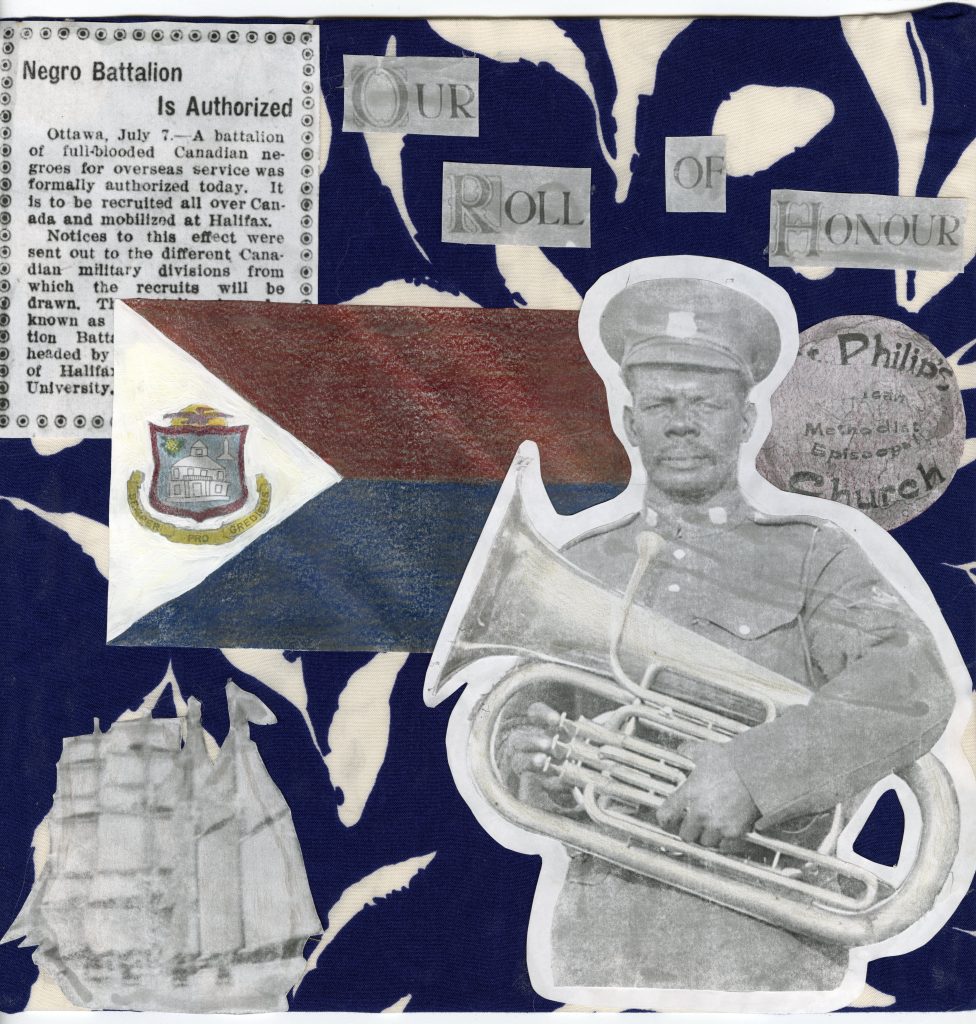
Albert Carty was born on 5 October 1879 in Sint Maarten, Dutch West Indies. Albert faced hardship early in life, losing both parents by the age of 10. After their deaths, he was placed aboard the windship Lady Jane, captained by his uncle, John George Brown. That first voyage led to a career at sea and a life-long love of ships.
Albert’s work on ships took him around the world. Shaped by the rough sea and the rugged men with whom he sailed, he eventually made his way to Atlantic Canada, where he worked under captains from Nova Scotia and New Brunswick. In 1904, he was working aboard the barque Alert under Captain James Calhoun when it came into port in Saint John, New Brunswick. While there, he met and fell in love with a local woman, Fannie Tyler. After years at sea, Albert decided to marry Fannie and settle in Saint John.
The couple wed on 13 June 1904 and quickly started a family. Sadly, only two of Albert and Fannie’s first four children survived infancy. To support them, Albert took whatever work he could find. Oral histories describe him loading and unloading ships in port and working various labour jobs. By 1911, Albert was employed as a mason. Around that time, Albert, a lover of music, joined the St. John Brass Band, a new all-Black brass band that became well-known for its concerts, picnics, and moonlit riverboat excursions.
In 1915, the band had the honour of playing at the opening of the Fredericton Exhibition. This would be their last performance there. Two months later, several band members, including Albert’s brothers-in-law, Seymour and Elijah Tyler, enlisted in Saint John and travelled to Sussex for training with the 104th Battalion. There, Lieutenant Colonel George Fowler, the unit’s Commanding Officer, rejected 19 Black recruits, saying he “did not think it fair” that white soldiers should “mingle with Negroes.”
After the men returned to Saint John, members of the St. John Brass Band helped form one of New Brunswick’s first Black civil rights groups. They not only demanded answers after Fowler’s rejection of Black volunteers but also advocated against the racism they were experiencing at local businesses. Albert is believed to have been part of this effort.
There was a tradition of military service in Albert’s family. He later recalled that several of his mother’s relatives had served in the Dutch Army and remembered a sword his grandfather once carried while serving. In July 1916, the Canadian government authorised the formation of No. 2 Construction Battalion. Two months later, Albert enlisted with the unit.
Albert left his pregnant wife and five children to travel by train to Truro, Nova Scotia, along with his in-laws and several other Saint John bandmates. Albert went overseas with No. 2 Construction in March 1917, serving with distinction in the Jura mountains of France alongside Canadian Forestry Corps Companies and earning a promotion to Corporal in the fall of 1918. He remained with the unit until the end of the war and was discharged at Fredericton on 13 February 1919.
Back home in Saint John, Albert stayed active in the local community. He and Fannie continued to grow their family but lost three more children over the years. Despite hardships, Albert remained devoted to his family and his community. He took up model shipbuilding, a skill that reflected his life-long bond with the sea. With Fannie sewing the sails, he built an estimated 300 ships over the years, each one constructed with care and precision. After Fannie’s death in 1945, Albert moved to Fredericton for a time before relocating to Ontario to live with one of his sons. He passed away there on 7 December 1958.Albert’s leadership skills and sense of duty shaped his sons. Adolphus, William, Clyde, Donald and Gerald all enlisted in the Royal Canadian Air Force during the Second World War. The two youngest also went on to enlist after the Second World War, Robert with The Royal Canadian Ordinance Corps and Malcolm with The Royal Canadian Regiment.
Though best known as the father of the “Carty Brothers,” Albert’s journey from the Caribbean to Canada, the family he built, and his lifelong commitment to community and craftsmanship have become a lasting legacy in the Carty family.
Additonal Research Outcomes
Census Records
The census is an institution that unites all Canadians. It is one of the main tools that the Canadian government uses to categorize and analyze people across the nation. However, census records do not always work in harmony with one another as each census is conducted by different people at different times, sometimes with new categories and standards for data collection. While there may be some issues with accuracy, these documents are a snapshot of the nation’s people. It is important to remember that these are historical documents influenced by the attitudes and norms of the day.
Supplementary Material
This additional material was consulted by Toronto Ward Museum researchers to fill in Albert Carty’s story. Some materials are indirectly related to the soldier, but help provide a fuller understanding of who he was. What other information sources would you look for if you wanted to know more?
Transcript of an interview with Donald Carty, conducted by Diana Braithwaite-Spence for the Multicultural History Society of Ontario and Ontario Black History Society, in 1982.