
From the West Indies to the First World War:
Stories from No. 2 Construction Battalion and Black Soldiers
Company Quarter Master Sergeant George Frederick Alberga (1892 – 1960): Reaching Academic and Military Heights
Biography
When Canada called for its men to take up arms during the First World War, many responded, even individuals the British Dominion did not expect. After considerable protest, No. 2 Construction Battalion was formed as a separate non-combat unit in the Canadian military to accommodate approximately 800 Black men from across Canada eager to serve their country. Among its enlistments was George Fredrick Alberga.
George was born in Black River, Jamaica, British West Indies, on 29 April 1892 to George Frederick Sr. and Ellen Alberta (Samms) Alberga. The couple’s oldest child, George became a brother to Albert Miller Alberga two years later. Another six children—three boys and three girls— joined the family prior to George Frederick Sr.’s death in September 1907. The following spring, Ellen gave birth to a sixth son.
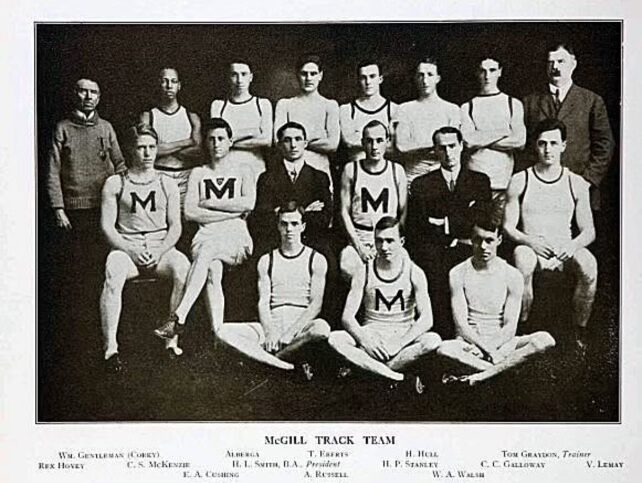
On 14 September 1911, George arrived in New York, NY, on his way to Canada, where he enrolled in McGill University, Montreal, Quebec. He soon became a well-known scholar and athlete. In 1913, George won third prize in Mathematics during his second year as an Applied Science student. He was also a member of McGill’s track and field team in 1915, placing among the top three finishers in a race. George and his brother Albert went on to obtain Bachelor of Science degrees in Civil Engineering in the same year, and both were named to McGill’s honour roll.
Albert was the first to enlist for service in The Great War, joining No. 2 Construction Battalion in Montreal on 8 September 1916. George followed three weeks later and signed his attestation papers in Truro, Nova Scotia, on 10 October 1916. The segregated unit was part of the Canadian Expeditionary Force (CEF), where it expected to carry out labour and engineering support tasks.
During the six months George spent in Canada, he earned several promotions. The day after completing his attestation papers, he was promoted to Corporal. Six days later, he advanced to the rank of Sergeant and was appointed Acting Company Sergeant Major—the second-highest non-commissioned rank in the CEF—on 20 October 1916.
George and his No. 2 Construction Battalion comrades departed from Halifax aboard SS Southland on 25 March 1917 and arrived in the United Kingdom on 7 April 1917. To advance the opportunity to serve on the European continent, George reverted to ranks and landed in France with a large party of No. 2 Construction men on 17 May 1917.
The following day, George was once again promoted to the rank of Sergeant. He proceeded with his comrades to the Canadian Forestry Corps’ (CFC) Jura District, near the Franco – Swiss border, where No. 2 Construction personnel commenced work alongside three CFC Companies, participating in all facets of their timber harvesting and processing operation.
George served in the Jura District until 30 December 1917, when he and a group of his No. 2 Construction comrades were transferred to CFC’s No. 1 District, Alençon, Normandy. Many were Caribbean natives, unaccustomed to Jura’s winter conditions. Medical officials’ concerns for their health led to their transfer to a region of France where the weather was much less severe.
On 10 September 1918, George was promoted to the rank of Acting Company Sergeant Major. Two weeks later, he returned to the Jura District, where he spent the remainder of his time in France. On 14 December 1918, he accompanied his No. 2 Construction comrades to the United Kingdom, where they prepared to return to Canada.
George left the United Kingdom aboard SS Baltic on 29 January 1919 and was discharged from military service at Montreal one month later. George gave his address as Strathcona Hall, one of McGill campus’s oldest buildings. At the time of the 1921 Canadian census, he and his brother Albert were living in an apartment on Guy St., located in Montreal’s St Joseph Ward. George listed his occupation as civil engineer, while Albert was employed as an insurance agent.
In October 1922, George travelled to New York, NY, and departed for Jamaica. On 1 October 1924, he married Agnes Emily Hamilton, a native of Torpichen, Linlithgow, Scotland. Four children, including a set of fraternal twins, joined the Alberga family over the next six years. Sometime after the birth of their youngest child in 1930, George and Agnes appear to have parted ways.
In January 1932, George returned to New York, where he married Vivian McCreath, a West Indies native, in St. Martina Church, New York, on 27 July 1935. The couple later welcomed one son into their home. At the time of the 1950 United States census, George and Vivian were residing in Manhattan, New York. George Frederick Alberga passed away in Toronto, Ontario, on March 22, 1960. His final resting place is unknown.
Census Records
The census is an institution that unites all Canadians. It is one of the main tools that the Canadian government uses to categorize and analyze people across the nation. However, census records do not always work in harmony with one another as each census is conducted by different people at different times, sometimes with new categories and standards for data collection. While there may be some issues with accuracy, these documents are a snapshot of the nation’s people. It is important to remember that these are historical documents influenced by the attitudes and norms of the day.
Supplementary Material
This additional material was consulted by Toronto Ward Museum researchers to fill in George Frederick Alberga’s story. Some materials are indirectly related to the solider, but help provide a fuller understanding of who he was. What other information sources would you look for if you wanted to know more?
In the 1914 McGill Yearbook, George Frederick Alberga appears page 175, as part of the Class of 1915 in Science. He appears again on page 254 as part of the track team.
In the 1915 McGill Yearbook, George Frederick Alberga appears page 147, as part of the graduating class in Science. He appears again on page 250 and 251 as part of the track team.
McGill University published a commemorative volume to honour those who served in the Frist World War in 1926. The Alberga brothers appear on the top of page 100.