
From the West Indies to the First World War:
Stories from No. 2 Construction Battalion and Black Soldiers
Company Sergeant Major Ethelbert Lionel Cross (1890 – ?):
A Pioneer of Justice, Resistance, and Representation in Canadian History
Biography
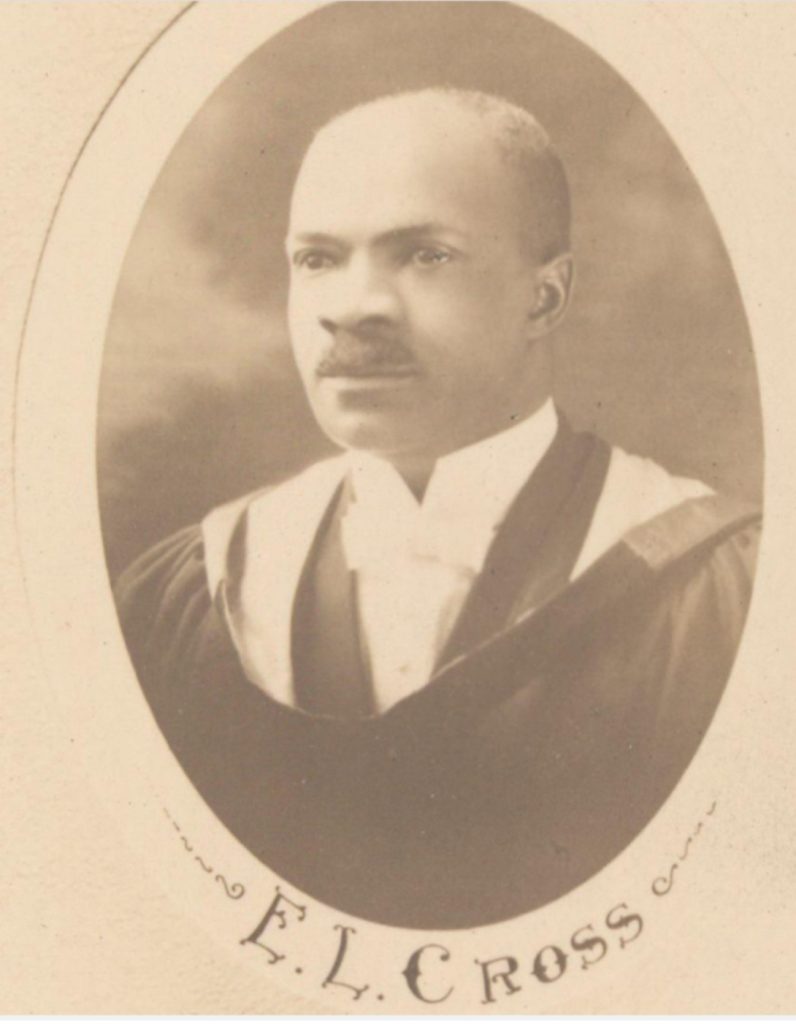
Ethelbert Lionel Cross was a lawyer, soldier, journalist, and advocate who defied racism and stood up for justice. Born in the British West Indies and educated in Canada, Lionel became the first Black lawyer to establish a practice in Toronto and played a key role in resisting the Ku Klux Klan during a terrifying 1930 incident in Oakville, Ontario.
Lionel was born in San Fernando, Trinidad, to François and Eloise Cross on 29 October 1890. Educated at Naparima College, a secondary school established and operated by Presbyterian missionaries from Nova Scotia, he landed in New York City in October 1910 and soon obtained a journalist position with a local newspaper. During his time there, his father passed away, leaving Lionel as his widowed mother’s and younger sister’s sole supporter.
In 1915, Lionel relocated to Halifax, Nova Scotia, where he joined the staff of The Atlantic Advocate, Nova Scotia’s first African Canadian newsmagazine. Founded that same year, the publication was devoted to the interests of Black Canadians and covered topics ranging from politics and religion to military service and civil rights.
Lionel was later appointed the publication’s editor. A news item published in The Atlantic Advocate’s January 1917 edition mentioned the enlistment of six Hammonds Plains men with No. 2 Construction Battalion, “the result of one day’s recruiting by Sergeant-Major Da Costa and E. L. Cross” on 2 December 1916.
Exactly one month later, Lionel enlisted in No 2 Construction Battalion at Halifax. On 1 February 1917, he was promoted to the rank of Provisional Sergeant. He sailed for the United Kingdom with the unit aboard SS Southland on 28 March 1917. Upon arriving in England on 7 April 1917, Lionel was promoted to the rank of Acting Sergeant.
On 17 May 1917, Lionel landed in France and headed for the Jura mountains near the Swiss border with a large group of No. 2 Construction personnel. Upon arrival, the men commenced work alongside three Canadian Forestry Corps (CFC) Companies, harvesting and processing timber from the area’s forests.
Lionel was part of a group of No. 2 men attached to No. 1 District CFC, Alençon, Normandy, in late December 1917. As his time in France came to an end, he was promoted to Company Sergeant Major with pay. He returned to England with his unit in mid-December 1918 and was assigned to duty at Camp Kinmel, Rhys, Wales, on 13 January 1919. Lionel remained there until mid-June 1919, when he returned to Canada and was discharged from military service at Halifax on 27 June 1919.
After the war, Cross pursued legal studies at Dalhousie University, Halifax, and graduated in 1923. He then moved to Toronto to attend Osgoode Hall Law School and was called to the bar in March 1924, becoming Toronto’s first and Ontario’s fourth known Black lawyer.
Lionel’s legal career focused on defending civil liberties, representing marginalized individuals and challenging systemic injustice. One of his most famous cases was R. v. Sterry (1927), Canada’s most prominent blasphemy trial, where Cross defended a man accused of mocking religious beliefs.
Cross’s most dramatic confrontation with racism occurred in Oakville, Ontario, on 28 February 1930. That night, 75 white-robed members of the Ku Klux Klan marched through town, burned a cross in the street, and forcibly separated an interracial couple—Ira Junius Johnson, a Black First World War veteran, and Isabella Jones, a young white woman. The Klan abducted Jones and returned her to her family, then kidnapped Johnson and his elderly relatives, trapping them in Ira’s home while another cross burned outside.
The attack was meant to terrorize the couple and prevent their marriage. Reports suggest that a police officer shook hands with the Klansmen and made no arrests. Ethelbert Lionel Cross became involved in the legal proceedings that followed, helping to challenge the Klan’s actions and defend the rights of the victims.
Cross gathered support from Jewish groups and trade unions, and galvanized public opinion to force the authorities to act. The resulting court case was the first prosecution of its kind in Canada and resulted in a conviction.
Outside the courtroom, Cross remained active in journalism and community organizing. He continued to write and speak out against injustice, blending sharp analysis with moral conviction. He also had a deep love for cricket, a sport rooted in Caribbean culture and colonial history, one he had learned during his school days.
In January 1937, Lionel was disbarred from the Law Society of Upper Canada for misappropriating client’s funds. Recent researchers have speculated that the charge may have been the local legal establishment’s response to numerous occasions in which he “had been deferential to no authority except the concepts of liberty and justice.” During his 13-year career, most of his clients were individuals “on the margins of society” with little means, leaving one to wonder how they managed to pay for his services.
Cross and Johnson represent two sides of the fight for justice—one in the courtroom, the other in the community. Their lives remind us that history is shaped not just by famous names, but by everyday heroes who refuse to be silent. They challenged racism, defended dignity, and stood up for what was right, even when the system resisted.
Details on Ethelbert Lionel Cross’s life after his disbarment remain a mystery. While a contemporary acquaintance later stated that he worked as a legal clerk for the City of Toronto for several years, efforts by several researchers to determine further details, including the date and location of his death, were unsuccessful.
Census Records
The census is an institution that unites all Canadians. It is one of the main tools that the Canadian government uses to categorize and analyze people across the nation. However, census records do not always work in harmony with one another as each census is conducted by different people at different times, sometimes with new categories and standards for data collection. While there may be some issues with accuracy, these documents are a snapshot of the nation’s people. It is important to remember that these are historical documents influenced by the attitudes and norms of the day.
Supplementary Material
This additional material was consulted by Toronto Ward Museum researchers to fill in Henry Isaac Phill’s story. Some materials are indirectly related to the solider, but help provide a fuller understanding of who he was. What other information sources would you look for if you wanted to know more?
Learn more about Ethelbert Lionel Cross’ time as Toronto’s First Black Lawyer in this chapter, by Susan Lewthaite and Barrington Walker, in the academic journal African Canadian Legal Odyssey, published by the University of Toronto Press, 13 November 2012.