
From the West Indies to the First World War:
Stories from No. 2 Construction Battalion and Black Soldiers
Corporal Henry Isaac Phills (1896 – 1985): A Legacy of Service, Strength, and Family
Biography
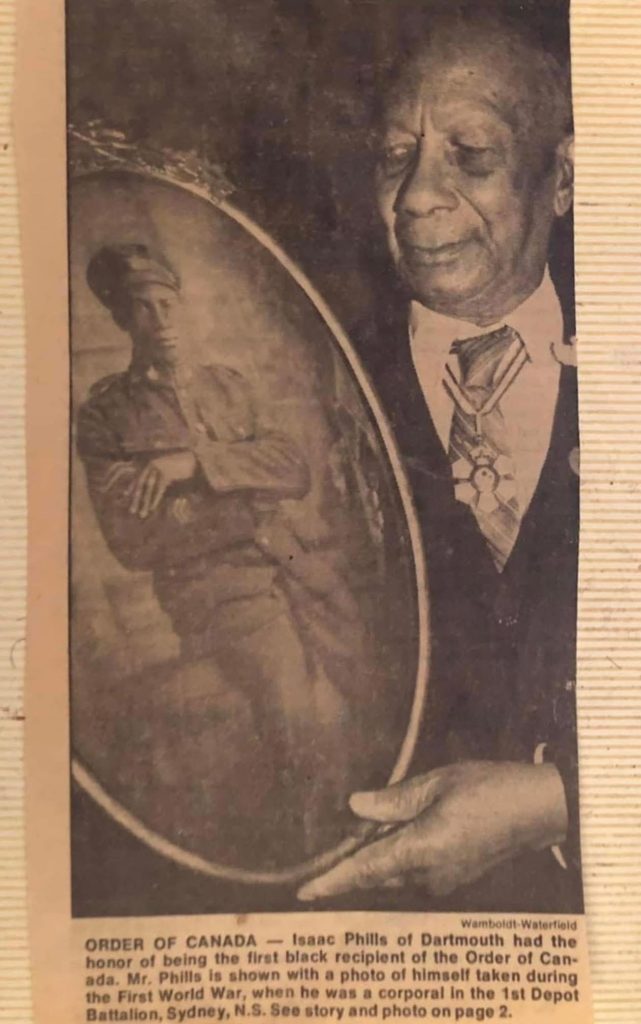
Henry Isaac Phills was a hard-working, confident Canadian. During his lifetime, he overcame racism and discrimination, worked in situations where he wasn’t welcome, became a war veteran and steel plant worker, supported a family, and became the first Black man to receive the Order of Canada.
Henry Isaac Phills was born into poverty in Prospect, St. Vincent and the Grenadines, British West Indies, on 11 January 1896, the son of Henry and Elvira (Edwards) Phills. Isaac completed “agriculturalist” training in his island homeland before immigrating to Cape Breton, Nova Scotia, in 1916. As there was no opportunity to put his skills to use there, he found employment at the Dominion Steel and Coal Corporation (DOSCO) steel mill in Sydney.
The First World War was well underway at the time of Isaac’s arrival. During its early years, military recruiters told most Black volunteers, “We don’t want you. This is a white man’s war.” As combat extended into a third year, Canadian units overseas faced manpower shortages, leaving the federal government with little choice but to introduce conscription.
During the summer of 1917, the Canadian Parliament passed the Military Service Act, allowing the government to implement conscription later that year. Isaac later commented, “At that point, they were willing to take anyone…. [T]hey took blacks and whites. You had no choice—you had to go.”
In early November 1917, Isaac completed a compulsory medical examination in Sydney. On 22 May 1918, he was conscripted into military service in the same location and proceeded to Camp Aldershot, Nova Scotia, where he underwent infantry training alongside other white draftees. He departed for overseas in mid-August 1918 and was “taken on strength” by the 17th Reserve Battalion (Nova Scotia) at Aldershot, England, on 18 August.
After a mandatory four weeks in an isolation camp, a precaution designed to prevent the spread of communicable illnesses such as mumps, Isaac joined the 17th’s ranks. By that time, there was little chance of a transfer to France. On 15 November, Isaac was assigned to the Canadian Forestry Corps Base Depot, Sunningdale.
At some point during his time in England, Isaac was promoted to the rank of Corporal. Transferred to the Canadian Discharge Depot (CDD), Rhyl, Wales, in mid-December, he was assigned to duty at Kinmel Park, Wales, on New Year’s Day 1919. Isaac spent one month there before returning to CDD. On 14 June 1919, he departed for Canada aboard HMT Aquitania and arrived in Halifax six days later. He was formally discharged from military service before month’s end.
Isaac returned to his position at the Sydney steel mill, where he worked until his retirement in 1963. During that time, Isaac supported his wife, Mary Isabel Alda Brereton, whom he married in 1924, and their seven children—four sons and three daughters. Isaac and Mary Isabel strongly believed in the importance of education. With their parents’ support and encouragement, the Phills children pursued careers in religious ministry, medicine, chemistry, education, and nursing. Several completed post-graduate studies.
Isaac was also active in his community. A member and vestryman of Saint Alban’s Anglican Church and treasurer of the Ethiopian Community Club, he was an active supporter of the Canadian Cancer Society and Canadian Red Cross.
During Canada’s 1967 Centennial celebrations, Isaac received the country’s highest civilian honour when he was named to the Order of Canada, in recognition of his dedication to family and community. The official citation celebrated Isaac as “a Cape Breton steel worker of West Indian origin, who raised a large family and despite many difficulties, gave them a good education and start in life and set a fine example in the community.” Isaac was the first person of African descent to receive this recognition.
In his later years, Isaac relocated to Dartmouth, NS. In 1981, he was part of a committee that organized a reunion of Black First World War veterans. The event included members of No 2. Construction Battalion, as well as men who served with other Canadian Expeditionary Force units.
Henry Isaac Phills died in Dartmouth General Hospital on 9 March 1985, leaving behind a legacy of hard work and community service.
Census Records
The census is an institution that unites all Canadians. It is one of the main tools that the Canadian government uses to categorize and analyze people across the nation. However, census records do not always work in harmony with one another as each census is conducted by different people at different times, sometimes with new categories and standards for data collection. While there may be some issues with accuracy, these documents are a snapshot of the nation’s people. It is important to remember that these are historical documents influenced by the attitudes and norms of the day.
Supplementary Material
This additional material was consulted by Toronto Ward Museum researchers to fill in Henry Isaac Phill’s story. Some materials are indirectly related to the solider, but help provide a fuller understanding of who he was. What other information sources would you look for if you wanted to know more?