
From the West Indies to the First World War:
Stories from No. 2 Construction Battalion and Black Soldiers
Private William Gale (1878 – 1954): No Stranger to Hard Work
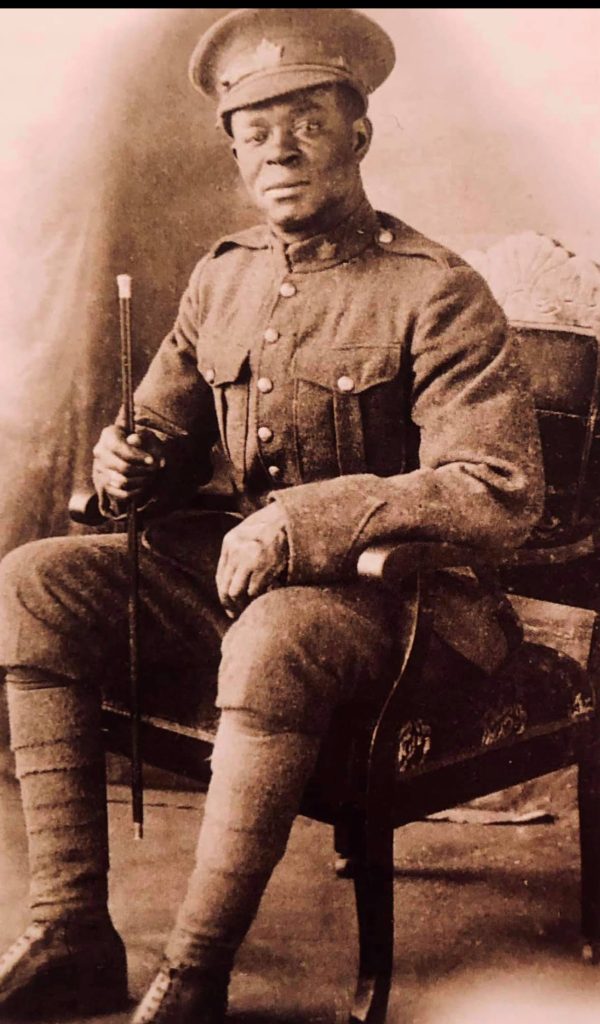
Biography
William Gale was born on 04 September 1878 in Falmouth, Trelawny, Jamaica, to William Gale Sr. His mother’s name is unknown. No further information has been uncovered on his early life, but available records state that he entered the United States at New York in 1904.
William enlisted with No. 2 Construction Battalion in Montreal, Quebec, on 16 September 1916. He was living at 183 Inspector Street at the time and gave his occupation as “blacksmith.” He was five feet, seven inches tall and 38 years of age, with dark eyes and hair and a “Coloured” complexion. William initially claimed to be single and listed his sister, Margaret Gale of Falmouth, Jamaica, as his next of kin. However, this entry was subsequently altered to read “Caroline Gale” (wife), 200 Metcalfe Street, Ottawa.
Following his enlistment, William reported to No. 2 Construction Battalion’s headquarters, Truro, NS. While training there, he met Dona Caroline Bonotra, a native of Ceylon (Sri Lanka). The couple married in the Cornwallis St. Baptist Church, Halifax, on 01 January 1917 and then returned to Truro, where William continued his preparations for overseas service.
William sailed for the United Kingdom with No. 2 Construction Battalion in April 1917 and proceeded to France in mid-May. He served in the Canadian Forestry Corps’ Jura District until 30 December 1917, when he proceeded to No. 1 District, Alençon, with a detachment of No. 2 Construction men. Most were British West Indies natives and officials were concerned that harsh winter conditions in the Jura mountains would negatively affect their health.
While details of William’s duties in Jura and Alençon are unknown, his blacksmith skills would have been useful in both locations, as horses were widely employed in the Forestry Corps’ timber operations. In late August 1918, he received two weeks’ leave to the United Kingdom and was awarded a Good Conduct Badge early the following month.
On 12 December 1918, Private Gale and his No. 2 Construction comrades returned to the Nova Scotia Regiment Depot, Bramshott. In late December, personnel proceeded to a repatriation camp at Rhyl, Wales. On 12 January 1919, the unit boarded SS Empress of Britain and departed for Halifax. Upon arriving in port after a 10-day voyage, William made his way by train to Montreal, where he was discharged from military service on 13 February 1919.
Private William Gale had served for a total of 29 months, 20 of which were spent in France. He received a war gratuity of $100, a portion of which had been sent to his wife Dona, who was living at 141 Lusignan St., Montreal. By the time of 1921 Canadian census, the couple had relocated to 1014 St. James St. In addition to William and Dona, the Gale household included a three-year-old son, “William F. A.,” who does not appear in subsequent records. This may have been William and Dona’s first-born, Thamis William Ebert, who was born in Montreal on 02 January 1921.
A second son, Frederick Carolis Develion Gale, was born in Montreal on 04 July 1924. Five weeks prior to Frederick’s birth—24 May 1924—William had entered the United States at Detroit, stating that he was 45 years old and a labourer. He planned to reside with a friend, William Duke, who worked in a steel plant, and intended to become a permanent resident. At the time, his wife Caroline was residing at Glengarry Avenue, Windsor, Ontario.
Despite William’s visit to Detroit, the couple eventually returned to Montreal, where Frederick was baptized on 08 February 1925. At the time of the 1931 Canadian census, the family was living at 799a Marmette St. While William claimed to be employed by the “City Dept. Public Works,” he reported no income for the previous year. In response to the question “Why not at work?” the entry on the form states “No Job,” suggesting that William had been laid off due to impact of the Great Depression.
William Gale died on Valentine’s Day 1954 and was buried in the National Field of Honour Cemetery, Point-Claire, Quebec, a burial ground reserved for military veterans.
William’s son Thamis served as a Signalman in the Canadian Army from 1940 to 1945 and was later instrumental in researching the names of men who served with No. 2 Construction Battalion. He gathered 1,300 names from various sources before his death in 1991. Like his father, Frederick is also buried in the National Field of Honour Cemetery, but his military service has not been traced.
Census Records
The census is an institution that unites all Canadians. It is one of the main tools that the Canadian government uses to categorize and analyze people across the nation. However, census records do not always work in harmony with one another as each census is conducted by different people at different times, sometimes with new categories and standards for data collection. While there may be some issues with accuracy, these documents are a snapshot of the nation’s people. It is important to remember that these are historical documents influenced by the attitudes and norms of the day.
Supplementary Material
This additional material was consulted by Toronto Ward Museum researchers to fill in William Gale’s story. Some materials are indirectly related to the solider, but help provide a fuller understanding of who he was. What other information sources would you look for if you wanted to know more?