
From the West Indies to the First World War:
Stories from No. 2 Construction Battalion and Black Soldiers
Sergeant Sydney Harrsion Flood
(1896 – 1979):
Service in two World Wars
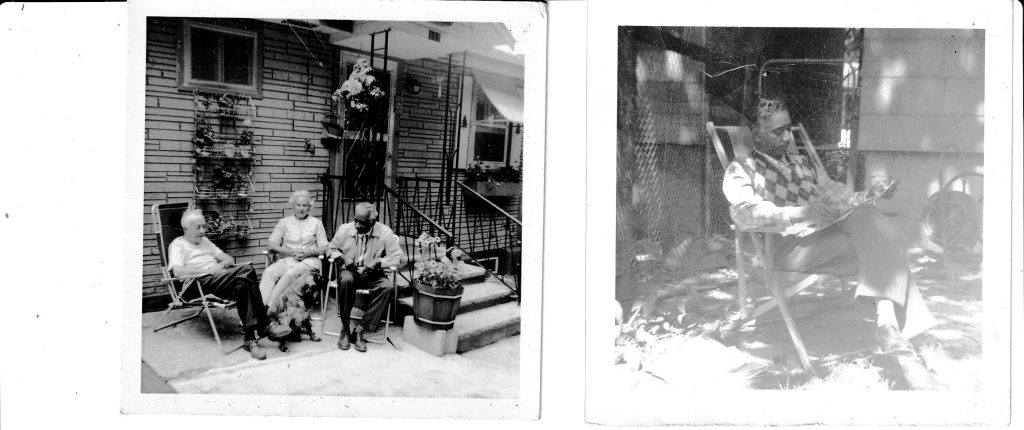
Biography
Sydney Harrison Flood was born in Georgetown, Queenstown Province, British Guiana, on 30 March 1896, the son of Charles and Maggie Flood. Sydney arrived in Sydney, Nova Scotia, aboard SS Boulama in 1913. Information in his Second World War service file states that he completed Grade 10 at Glace Bay High School and worked in the Glace Bay coal mines as a “driver and miner.”
On 28 July 1916, Sydney enlisted with No. 2 Construction Battalion in Sydney. The young soldier quickly impressed his superiors, earning promotions to Lance Corporal on 9 August and the full rank of Corporal on 12 December 1916.
No. 2 Construction Battalion departed for the United Kingdom (UK) aboard SS Southland on 25 March 1917. Eager to serve on the European continent, Sydney “reverted to ranks” on 17 May and joined a detachment of No. 2 personnel that departed for France the same day. Upon disembarking in Le Havre, the group travelled by rail to the Jura mountains, near the Swiss border, for service with the Canadian Forestry Corps (CFC). No. 2 Construction personnel worked alongside several CFC Companies in all aspects of the Jura lumber operation.
In late December 1917, Sydney was part of a group of No. 2 Construction men transferred to CFC’s Alençon District, Normandy. Many were natives of the southern United States and British West Indies, and officials were concerned that Jura’s cold winter weather would negatively affect their health.
On 18 September 1918, for unknown reasons, Sydney returned to the UK, where he was attached to Caesar’s Camp, Shorncliffe, Kent. Granted a two-week leave on 25 October, he was posted to the Nova Scotia Regimental Depot, Bramshott, on 14 December 1918. Later that month, he reported to the Canadian Discharge Depot, Kinmel Park, where he awaited return to Canada.
While most No. 2 Construction soldiers departed for Canada aboard SS Empress of Britain on 12 January 1919, Sydney was not among them. In late February 1919, he was admitted to No. 9 Canadian General Hospital, Kinmel Park, with mumps, further delaying his return.
Discharged from hospital in late March, Sydney departed for Canada aboard SS Cassandra on 2 May 1919. The vessel docked at Quebec, where he was discharged from military service on 14 May 1919. He immediately headed for Montreal, where he established residence at 530a St. Antoine St.
Upon returning to civilian life, Sydney found work as a “sleeping car porter” with Canadian Pacific Railway (CPR). At the time of the 1921 Canadian census, he was living at 52 Bonaventure St., Montreal, with his common-law wife Rosina Maud “Rose” Bonner, age 25, a Quebec-born English Canadian. That same year, Sydney commenced work as a station porter at the CPR’s Windsor Station, Montreal.
On 14 February 1923, Rose gave birth to a son, Victor Flood Bonner, in the Montreal Maternity Hospital. Sometime after their child’s birth, Sydney and Rose parted ways. On 20 July 1925, Sydney married Elsie Lambert in the Congregational Union of Negroes Church, Montreal. The daughter of Albert and Mary A. Lambert, Elsie had immigrated with her family to Canada from England in 1916.
Sydney and Elsie raised a family of two children—Sydney Harrison (DOB 1 April 1927) and Eugene Emerson (DOB 11 October 1928)—in their St. André St. home. Sydney’s 1925 marriage record and several other documents identify his occupation as “musician.” While he was a CPR employee for most of his working life, he was “granted [a] leave of absence, from time to time, to pursue Music studies,” completing courses at McGill College and travelling to Chicago, Illinois, for the same purpose on at least one occasion.
The outbreak of the Second World War prompted many First World War veterans to volunteer for military service in Canada. On 5 August 1940, Sydney enlisted with No. 4B Company, Veterans Guard of Canada, in Montreal. He spent the next 18 months “employed on Guard and escort duties” before qualifying as a “weapons training instructor.”
A “Methods of Instruction Assessment,” completed at S4 Small Arms School, Nanaimo, BC, in December 1944, described Sydney’s performance in the classroom: “Pleasant manner; sets the class at ease and they work well with him…. Organized and prepared his lessons well.”
Sydney was discharged from military service on 10 October 1945 and returned to his “former employment as Station Porter with CPR.” According to a 1952 Montreal Star profile of Windsor Station’s “red caps”—a reference to their distinctive head gear— Sydney was Senior Captain of the station’s 50 porters at that time.
Sydney spent the remainder of his working and retirement years in Montreal, passing away in Queen Elizabeth Hospital on 11 August 1979. He was interred in the National Field of Honour Cemetery, Point-Claire, Quebec. His wife Elsie died in Knowlbanks Residence, an assisted living facility located in Knowlton, Quebec, on 12 July 1993, and was laid to rest beside her husband.
Military Record
Selected files from Second World War Military Record
Census Records
The census is an institution that unites all Canadians. It is one of the main tools that the Canadian government uses to categorize and analyze people across the nation. However, census records do not always work in harmony with one another as each census is conducted by different people at different times, sometimes with new categories and standards for data collection. While there may be some issues with accuracy, these documents are a snapshot of the nation’s people. It is important to remember that these are historical documents influenced by the attitudes and norms of the day.
Supplementary Material
This additional material was consulted by Toronto Ward Museum researchers to fill in Sydney Harrison Flood’s story. Some materials are indirectly related to the solider, but help provide a fuller understanding of who he was. What other information sources would you look for if you wanted to know more?